
Open Cut Trenching in Hempstead
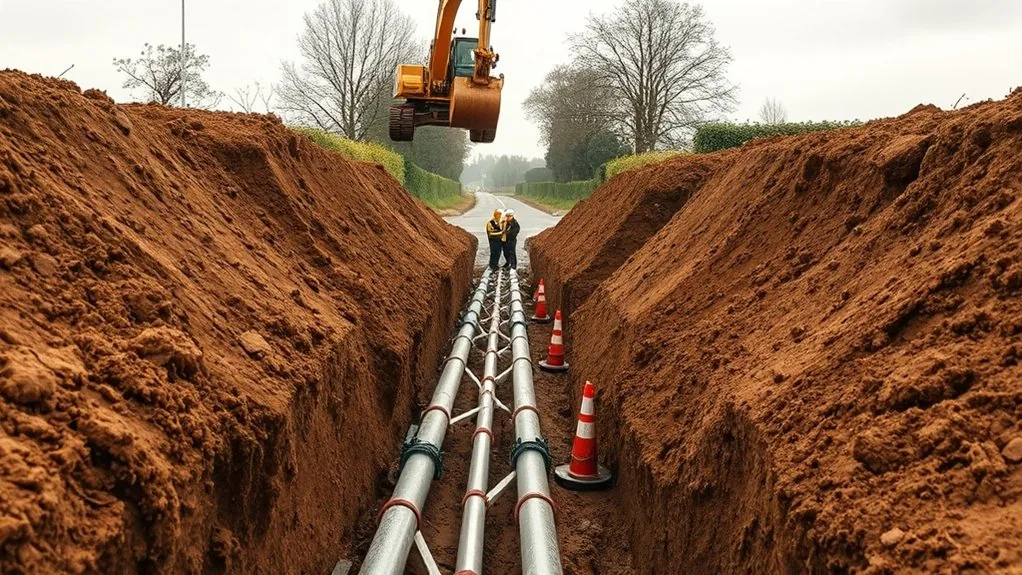
When you need fully exposed, standards-compliant excavation for installing or replacing utilities with precise alignment and verifiable clearances, open cut trenching in Hempstead provides a reliable solution.
This method is particularly suited to congested areas or sites requiring strict adherence to NRSWA, HAUC, and local authority standards.
For a fast quote or emergency callout in Hempstead, please get in touch.
So what exactly is open cut trenching in the context of civil and utility works in Hempstead? You’re dealing with conventional excavation where a linear trench is formed from ground level down to the design depth, with material removed and typically stockpiled or carted away. It’s used to install or replace pipelines, ducts, cables, or drainage runs with direct surface access.
You’ll define trench geometry (width, depth, side slopes) from design loadings, utility specifications, and local authority requirements. Trench safety is governed by standards-driven controls: shoring, battering, benching, edge protection, and access/egress. Soil analysis underpins every design decision, determining allowable trench depth, support class, and dewatering needs, while influencing compaction criteria, backfill selection, and settlement performance for long‑term asset integrity.
Although trenchless methods are increasingly available across Hempstead, open cut trenching remains the default solution when you need precise alignment control, full visual access to existing services, and verified compaction around new assets. You’ll typically specify it where positional tolerances are tight, service density is high, or regulatory oversight is stringent.
You need open cut trenching when you must:
You’ll follow a defined sequence for open cut trenching in Hempstead, starting with a site survey and marking to PAS 128 and HSG47 guidance. Excavation and spoil management must then be controlled to specified trench widths, support systems, and waste transfer documentation, before pipe laying and bedding are installed to the required line, level, and material grade. Finally, you’ll complete backfilling and reinstatement to compaction targets and surface standards (such as HAUC and local authority specifications) to restore structural integrity and compliance.
Before any excavation plant moves on site, a structured site survey and precise corridor marking establish the technical baseline for open cut trenching in Hempstead. You start by validating topographic data, existing utility records, and design alignments, then ground‑truthing them with GPS or total‑station measurements to sub‑centimetre accuracy.
You’ll assess soil stability using in‑situ testing (SPT, shear vane, or dynamic probing) and classify strata to BS EN ISO 14688, so trench widths, depths, and support systems are engineered, not guessed. Safety precautions follow a formal CDM 2015 and HSG47‑led risk assessment, including utility locating with CAT & Genny and, where necessary, vacuum potholing.
Finally, you’ll mark trench centrelines, offsets, exclusion zones, and service crossings with colour‑coded, weather‑resistant notation.
Once the corridor’s set out and services are cleared, excavation for open cut trenching in Hempstead shifts to controlled, phased digging that matches the engineered profile and support design. You’ll typically specify machine type, bite depth, and advance rate to maintain sidewall stability and compliant working widths under CDM and HSE guidance.
Spoil management hinges on segregation, testing, and logistics. You classify arisings by geotechnical and contamination status, then decide what’s reusable, what needs Soil stabilization, and what must be removed under duty-of-care rules, minimising Environmental impact.
| Spoil Class | Action | Key Standard / Outcome |
|---|---|---|
| Clean granular | Stockpile for reuse | BS 6031 good practice |
| Cohesive soft | Treat with lime/cement | Improved bearing capacity |
| Contaminated | Segregate, licensed disposal | WM3-compliant management |
| Excess neutral | Off-site recovery/recycling | Reduced haulage emissions |
Although excavation and spoil logistics set the framework, the performance of open cut trenching in Hempstead ultimately depends on how precisely pipes are laid and bedded to design line and level. You start pipe installation by verifying trench depth, gradient, and width against the drawings and the relevant Sewers for Adoption or Water Industry Specification standards.
You’ll place and compact selected bedding materials—typically graded granular aggregates—to a controlled thickness, ensuring uniform support without point loading. Pipes are then aligned with laser or GPS control, with joint gaps, rotation, and deflection kept within manufacturer tolerances.
You’ll check invert levels at each joint, confirm ovality and line with calibrated gauges, and document test results to demonstrate compliance before any further construction stages.
With pipe laying and bedding validated to line, level, and specification, the focus shifts to controlled backfilling and staged reinstatement of the trench in accordance with HAUC, NJUG, and Hempstead County Council requirements. You’ll typically specify selected granular surround to 150–300 mm above crown, compacted in ≤150 mm layers to achieve target dry density ratios verified by in‑situ testing.
Above this, you reinstate sub‑base and base layers to match existing pavement construction, using Type 1 or equivalent, compacted to prescribed modulus values to maintain soil stability and long‑term performance. You’ll control moisture content, lift thickness, and compaction passes to preserve trench safety and prevent settlement. Surface reinstatement then follows the local authority’s approved materials, joint treatment, and inspection regime.
When evaluating open cut trenching against traditional bulk excavation for utility installation in Hempstead, the key distinctions lie in excavation geometry, support methodology, production rates, and compliance with standards such as BS 6031 (Code of practice for earthworks), CDM Regulations 2015, and HAUC (UK) specification. You’re not just choosing a dig method; you’re managing risk, Environmental impact, and safety regulations.
| Method | Typical Width/Depth Ratio | Primary Control Focus |
|---|---|---|
| Open cut trenching | Narrow / deeper | Trench support & traffic |
| Traditional excavation | Wider / shallower | Bulk stability & haulage |
| Hybrid/sectional methods | Variable | Interface with existing plant |
Open cut trenching usually offers tighter control of settlement and service separation, while bulk excavation can simplify spoil management and plant access where corridors are less constrained.
Selecting open cut trenching over broader excavation approaches in Hempstead isn’t just a geometric preference; it typically delivers quantifiable gains in safety, programme certainty, and compliance. You’re working with a defined, linear footprint, so risks, costs, and durations are easier to model, monitor, and control.
Whether you’re upgrading a single dwelling in Maidstone or delivering a multi‑utility corridor for a business park in Ashford, open cut trenching provides a controlled method for installing, replacing, or diverting buried services to defined standards. In domestic settings, you’ll typically use it for water, gas, electric, telecoms, and drainage connections, ensuring compliant depths, bedding, and separation distances in line with NJUG and WRc guidance.
For commercial sites, open cut supports higher‑capacity mains, fire‑fighting supplies, and multi‑duct routes, allowing accurate asset mapping and future access. You can quantify Environmental impact through spoil volumes, reinstatement areas, noise windows, and waste transfer notes, then mitigate via selective excavation and recycled backfill. Robust Safety precautions—shoring, edge protection, confined‑space controls, and utility locating—keep operations CDM‑compliant.
From single‑plot service connections to multi‑kilometre utility corridors, our open cut trenching service covers the whole of Hempstead with methods and controls tailored to local ground conditions and statutory requirements. You get engineered solutions calibrated to chalk, clay, or made ground, with trench safety and environmental impact assessed at design stage, not as an afterthought.
We align plant choice, excavation sequence, and reinstatement to traffic sensitivity, utility density, and groundwater risk. Every site is managed to HAUC, NRSWA and CDM standards, with measurable performance criteria.
| Corridor Type | Typical Depth Range | Key Control Focus |
|---|---|---|
| Urban streets | 0.6–1.2 m | Service avoidance, noise control |
| Rural carriageways | 0.8–1.5 m | Drainage, verge stability |
| Farmland crossings | 0.9–1.8 m | Soil segregation, runoff |
| Industrial estates | 1.0–2.0 m | Load capacity, access phasing |
| Brownfield sites | 1.0–2.5 m | Contamination, vapour control |
Because open cut trenching in Hempstead sits at the intersection of safety‑critical excavation, traffic management, and strict utility regulations, you need a contractor whose processes are built around measurable controls, not rule‑of‑thumb digging. You get rigor: method statements aligned with BS 6031, CDM 2015, and HAUC Specification, backed by quantifiable risk assessments and auditable inspection records.
You also benefit from design choices informed by historical context and buried‑asset data, reducing strike risk and programme variance. Our teams model ground conditions, loadings, and support requirements, using factor‑of‑safety calculations rather than generic trench boxes. We quantify environmental impact too—spoil volumes, transport movements, noise windows, and reinstatement performance—so you can evidence compliance, minimise disruption, and defend your project to regulators and stakeholders.
You’ll want clear answers on how long open cut trenching typically takes, how its whole-life cost compares with conventional digging, and whether your specific location in Hempstead is within our service radius. In this FAQ section, we address those issues using indicative programme durations, cost benchmarks, and mapped coverage zones. Each response is grounded in current UK utility installation standards, local authority requirements, and recent project data from across Hempstead.
How long open cut trenching takes depends on multiple engineered variables, not a simple “days per metre” rule of thumb. You’ll need to factor in pipe diameter, trench depth, soil classification (per BS 5930), groundwater conditions, and required shoring or shielding for trenching safety under CDM Regulations.
Production rates vary significantly: in firm, dry soils with unobstructed access, a well-organised crew with maintained plant might achieve 20–60 linear metres per day; in urban Hempstead streets with dense utilities, that can drop below 10 metres. Equipment maintenance, pre-planned to OEM schedules, directly affects uptime and cycle times.
You’ll also need to account for survey, permits, traffic management, temporary works design, inspections, testing, and reinstatement, not just excavation hours.
Cost comparisons between open cut trenching and “just digging a trench” hinge on more than headline excavation rates. When you run a true cost comparison of excavation methods, you’ve got to quantify plant, labour, reinstatement, traffic management, and programme risk. Open cut is often cheaper for shallow, straight runs where you can use standard buckets and simple shoring compliant with BS 5975 and HSE guidance.
| Factor | Open Cut Trenching | “Just Digging” (Ad‑hoc) |
|---|---|---|
| Direct excavation cost | Moderate – predictable unit rates | Low – but highly variable |
| Compliance & safety | Higher – designed to standards | Lower – risk of non‑compliance |
| Reinstatement | Controlled, spec‑driven | Often higher remedial costs |
Across a full lifecycle, open cut trenching usually delivers a lower, more predictable cost per metre.
Most open cut trenching projects we deliver are across Hempstead’s primary infrastructure corridor, covering Medway, Maidstone, Ashford, Canterbury, Swale, Thanet, Dover, Folkestone & Hythe, Gravesham, Dartford, Tunbridge Wells, Tonbridge & Malling, and Sevenoaks. If your site sits within these districts, we can usually mobilise quickly with the appropriate plant, permits, and traffic management.
If you’re on the Hempstead border, we’ll assess feasibility using access distance, road category, and utility density data to determine whether open cut remains cost‑effective and compliant. We always factor in local regulations, including KCC highways requirements, Section 50/278 constraints, and utility owner specifications.
Before confirming, we’ll review drawings, ground conditions, and required safety precautions to ensure we can deliver a safe, standards‑compliant trench.
Yes, you need permission from Hempstead County Council before starting open cut trenching. You may need permits under the Highways Act and street works regulations, and possibly planning consent depending on the depth, location, and duration of the work. You must also submit method statements, traffic management plans, and environmental impact assessments if required, and coordinate with utility maps, CDM Regulations, and local standards to ensure compliance.
Open cut trenching can seriously damage nearby trees, hedges, and landscaping. Cutting more than 30–40% of roots often causes tree decline, so it is important to protect roots by following BS 5837:2012 guidelines and hand-digging near tree stems. The process can also compact soil, change drainage, and destroy fine roots within the top 600 mm of soil. Fencing, soil decompaction, and proper reinstatement should be specified, with survival rates checked through post-work arboricultural monitoring.
We provide public liability and contractor’s all-risk insurance with appropriate coverage limits, complying with CDM and trenching safety standards. Evidence of cover limits, exclusions, and endorsements is provided before mobilisation. Project warranties cover workmanship, reinstatement performance, and compliance with approved drawings and specifications, supported by manufacturer warranties on installed components and documented in the contract and handover pack with clear claims and defect-notification procedures.
Yes, we can usually work around live utilities without interrupting your water or power supply. A pre-start utility detection survey (PAS 128 or equivalent) is conducted to accurately map buried services. We use exclusion zones, hand-digging or vacuum excavation near services, and apply lock-out/tag-out only when essential, following continuous monitoring, method statements, and risk assessments to meet UK health and safety and utility provider standards.
You should prepare your site by ensuring it is a zero-error work zone. Clear access routes and mark all utilities within industry tolerance, usually ±150mm. Implement safety measures such as barriers, signage, exclusion zones, and emergency access. Check ground conditions and drainage paths. Inspect any client-supplied equipment for guards, fluids, and certifications. Provide up-to-date drawings, permits, and a site induction plan for our trenching team.
Ready to progress your project from planning to execution? Use our structured quotation process to obtain a precise cost model for open cut trenching in Hempstead. You’ll specify trench length, width, depth, ground conditions, and utility type so we can design a method compliant with CDM Regulations, HSG47, and relevant BS/EN standards.
We’ll factor in traffic management, spoil handling, backfill specifications, and reinstatement classes to give you transparent rates and programme durations. Our pricing also reflects robust safety protocols, shoring design, and plant selection aligned with current guidance.
You’ll receive a written, itemised quote detailing labour, materials, equipment, and contingency allowances, underpinned by planned equipment maintenance schedules that minimise downtime and reduce risk of on-site failure.